Event date: 21 October 2026
Maintenance date supplied by E3: 22 October 2026
Technical review documented: November 2026
Project area: Cloud server security & PHP runtime maintenance
The security issue
PHP2Shell refers to two PHP vulnerabilities, CVE-2026-109618 and CVE-2026-109619. They involve memory and request-state handling. In affected conditions, an attacker may achieve remote code execution with the permissions of the PHP web worker. Exposure depends on the PHP build, request handler, application and configuration.
What could happen if the vulnerabilities are exploited?
- Unauthorised code execution: an attacker may run code in the affected web application environment.
- Data and credential exposure: information accessible to the compromised application account could be read or stolen.
- Website or application tampering: files and content writable by that account could be changed, including the placement of malicious code.
- Service disruption: crashes, resource exhaustion or malicious changes could interrupt normal website and application operations.
These are potential consequences of successful exploitation. This project records preventive maintenance and scoped remediation; it does not describe a confirmed breach of our cloud infrastructure.
Our response
- Review the actual runtime: check installed PHP packages, vendor patch records and the PHP executable used by the reviewed workloads, rather than relying only on a control-panel version label.
- Align selected workloads with patched runtimes: move the scoped workload to a vendor-patched PHP runtime while retaining the required application settings.
- Retire obsolete PHP 5 runtimes: remove legacy interpreters and obsolete execution entry points after checking usage and keeping recovery evidence.
- Prepare recovery: preserve relevant configuration and system-file backups before production changes.
- Validate after changes: check selected website functions, PHP sessions and database support, web-server configuration and core service availability.
Project outcome
The scoped runtime changes and legacy PHP retirement were completed, with post-change checks recorded for the reviewed websites and services. The work reduced legacy execution paths and provided a documented basis for further maintenance.
Patch verification and application compatibility remain an ongoing process. This case study covers the work reviewed and performed; it is not a claim that every server, application or PHP configuration has been exhaustively assessed.
AI-assisted review & ongoing security improvement
Following the maintenance work, E3 used repeated AI-assisted reviews alongside log analysis and operational checks to help identify risks, cross-check findings and verify remediation. Findings were compared with actual runtime behaviour and service checks before deciding on changes.
Scheduled security checks and alerting support continued review of suspicious activity and changes in the environment. We use the results to guide further assessment and improvements to security defences, with the aim of protecting customer systems and service continuity.
Official technical reference images
The screenshots below come from the PHP project’s public security advisories. They illustrate the published vulnerabilities and patched versions; they are not photographs of an attack or screenshots of a customer server.
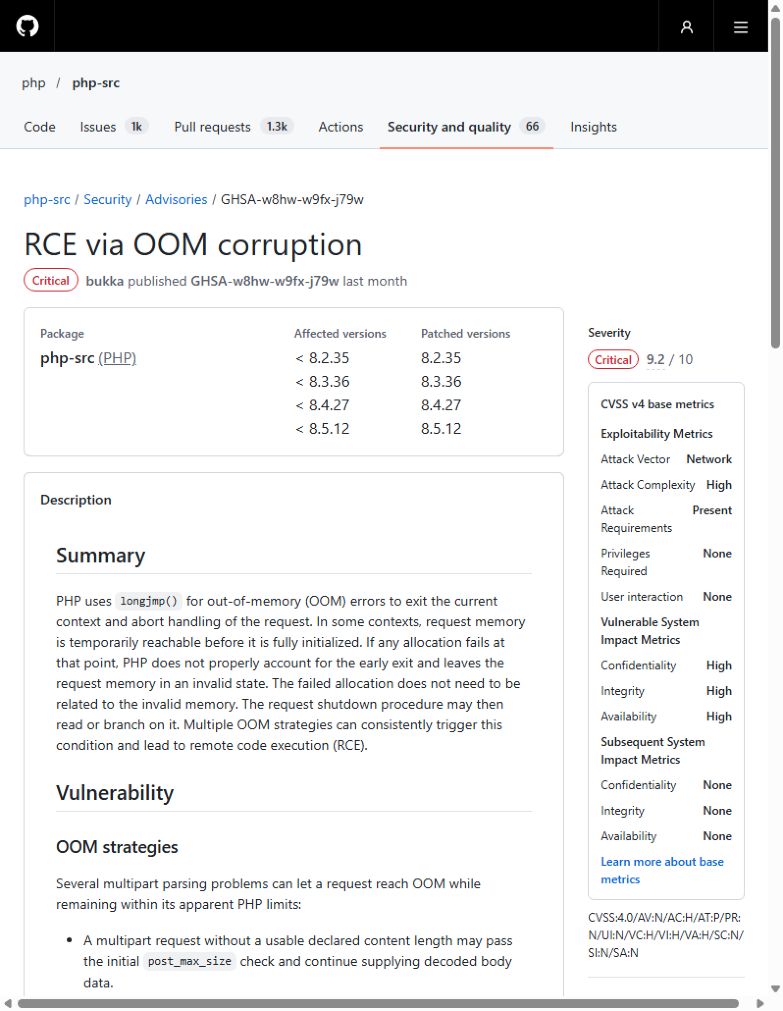
Official technical reference screenshot. View original source
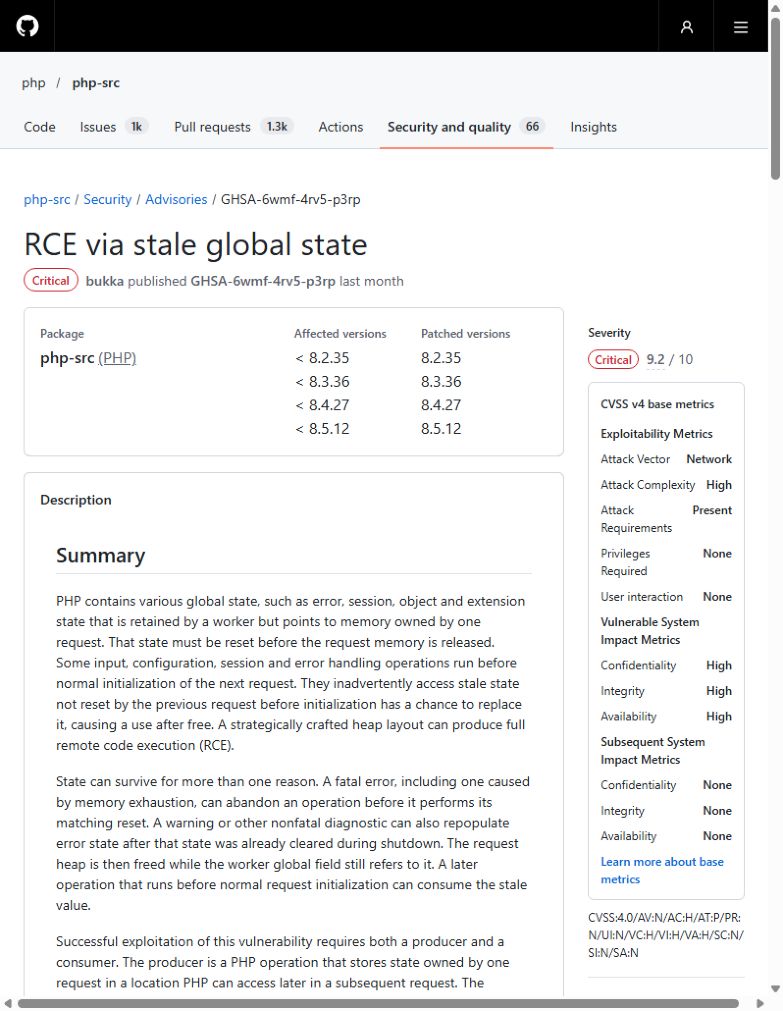
Official technical reference screenshot. View original source
Original sources & further reading
- PHP official advisory: RCE via OOM corruption — CVE-2026-109618
- PHP official advisory: RCE via stale global state — CVE-2026-109619
- PHP official changelog and security fixes
- CloudLinux: fixed PHP packages and patch verification
Need help reviewing your server environment? Contact E3 Information to discuss cloud infrastructure, maintenance and an agreed security assessment scope.